Categories:
Aura Context architecture and operation
Discover Aura Context functional architecture and its operational process
Functional architecture
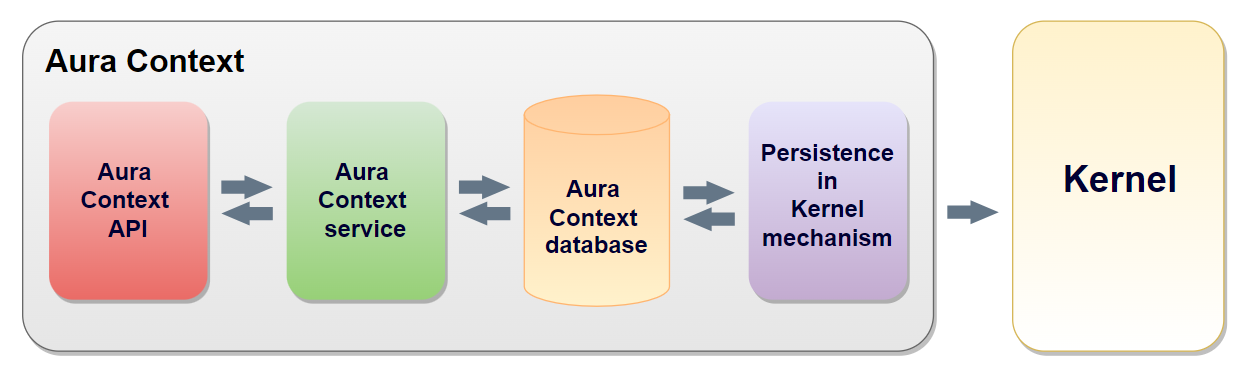
Aura Context v1 functional architecture contains the following components:
-
Context broker & server API
Server API in Aura Context for uploading, updating and recovering context data by different Aura sub-systems. -
Aura Context Service
Core module of Aura Context in charge of gathering data from the context API, uploading it into de context database and data recovery. -
Aura Context cache/database
Temporary high-performance database placed inside the Aura instance that is able to storage user’s data corresponding to the user’s previous experiences or environment. Data is available in the context database for a limited period of time and it cannot be recovered once this period expires.
The key features of Aura Context database are shown below:- 360 approach: Aura Context aims to gather all type of information from an Aura interaction, including data coming from channels.
- High-available database: real-time recovery during the user’s interaction, with no lateness.
- Temporary data storage: data available only for an established period of time.
- Data persistence in Kernel for historical data exploitation purposes.
-
Context Kernel persistence mechanism
First basic version of the Kernel persistence mechanism. Within a one-direction flow, context data stored in the database is sent to Kernel for an unlimited period of time. Data on Kernel can be checked or processed following the same procedure as for Aura data.
Aura Context performance
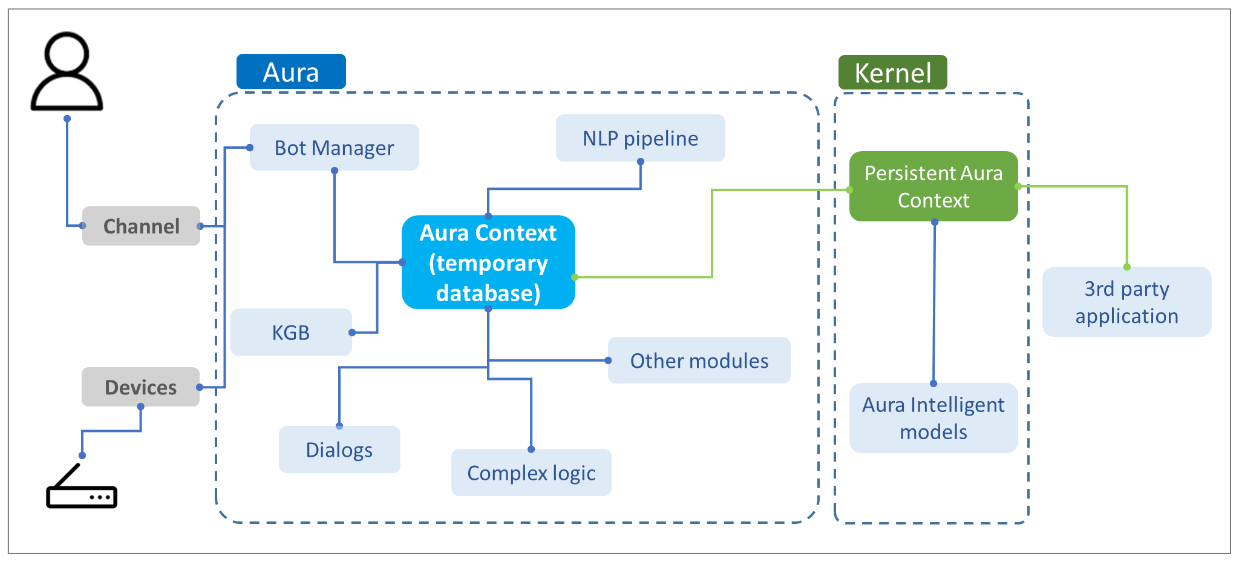
The following steps schematically shows the process carried out by Aura Context:
-
Context data is sent to Kernel where it is stored for an unlimited period of time.
-
This information can be retrieved by an external stakeholder just by calling the corresponding API.
-
Developers can consume data in the Aura Context database when developing a use case. For this purpose, the aura-bot dialog must call the corresponding API in order to retrieve context data and include it in the response to the user.
Aura Context operational flowchart
Before facing this section, it is recommended to read the document Aura Context components.
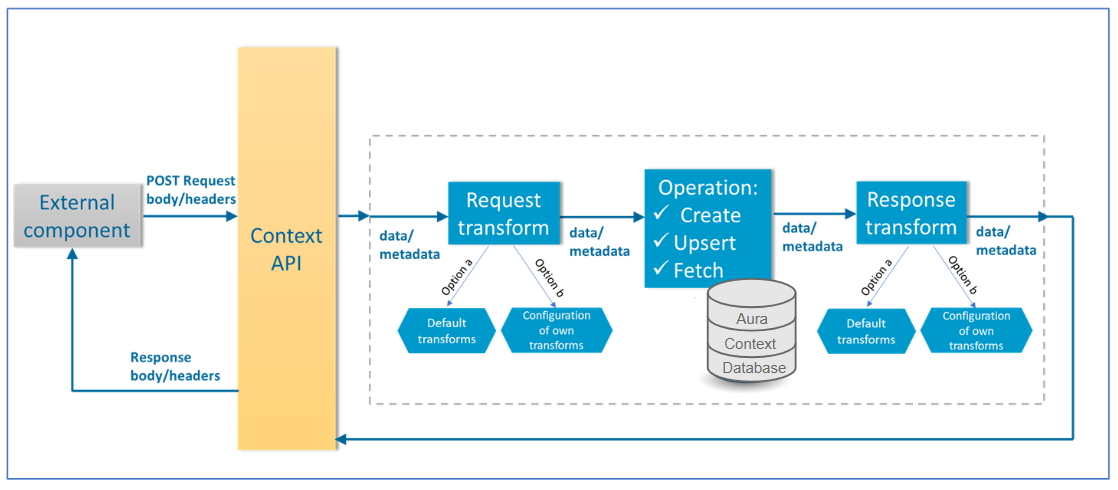
Considering the Aura Context components, the following flowchart shows the operational process carried out by the context:
- An external component makes a request to Aura Context API (POST HTTP request) for carrying out a specific operation:
- Create: creation of a data entry in Aura Context
- Upsert: modification of a data entry in Aura Context
- Fetch: data recovery from Aura Context
- The context API sends the request to Aura Context service.
- The request transform converts input data into data suitable with the Aura Context global data model.
- The specific operation is performed: Create / Upsert / Fetch.
- Output data from the operation is converted into data compatible with the user’s data model through the response transform.
- The response is sent back to the context API and provided to the external component.