Categories:
Introduction to Aura multibrand feature
Description of Aura multibrand feature, based on a multitenant architecture
Introduction
The OBs commercialize their Telefónica services through different brands (Movistar, O2, Vivo, Blau, Whatsapp SIM, etc.).
To align with this scenario, Aura (both Aura Virtual Assistant and ATRIA) is now designed as a multibrand virtual assistant, capable of providing services to multiple brands through a shared infrastructure.
The communication flow is similar to the one previous to the implementation of the multibrand feature (see Figure 2).
- A user can access Aura through the different Telefónica brands available in her country.
- Within a specific brand, the connection to Aura is done through a particular channel.
- The user can now submit a request (use case) and have it resolved, as long as the use case is available in this specific channel.
Overview of the multitenant architecture
Aura multibrand feature is based on a multitenant architecture.
In the multitenant architecture, we introduce the concept of tenant, defined as the deployment associated to a specific brand.
Aura multibrand feature operates in different scenarios:
- In Aura Virtual Assistant (use cases resolved by a bot or skill)
- In ATRIA (use cases resolved by AI-powered LLM models)
In both scenarios, Aura Virtual Assistant and ATRIA are structured in different tenants, each of them associated to a specific brand and with isolated deployment and operation.
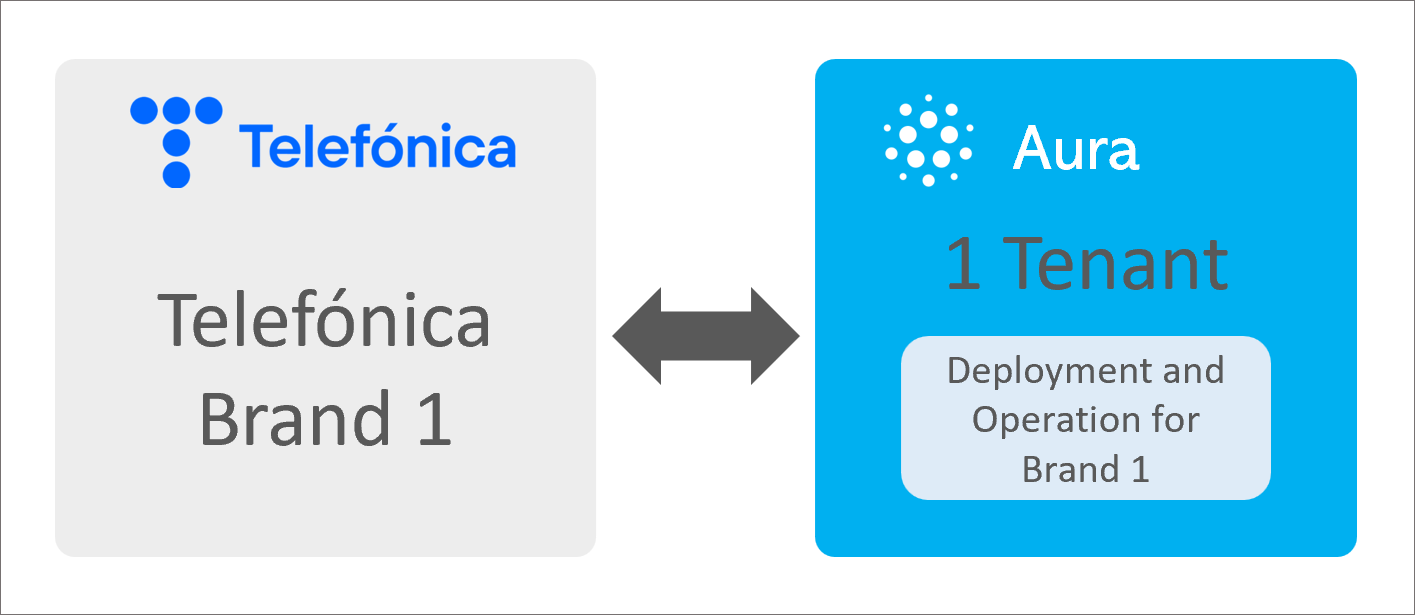
Relationship between brand and tenant
There is not physical separation between Aura components in each brand, but logical separation.
As well as Aura, Kernel also supports a multitenant architecture. A tenant in Kernel is defined as a logical way of isolating resources within a Kernel instance.
A use case submitted from a specific brand will be resolved using the Kernel tenant associated to this brand.
See more details of the specific behavior of the multitenant architecture in:
Functional multitenant architecture in Aura Virtual Assistant
An overview of the functional operation of the multibrand feature based on multitenant architecture in Aura Virtual Assistant is shown and explained below:
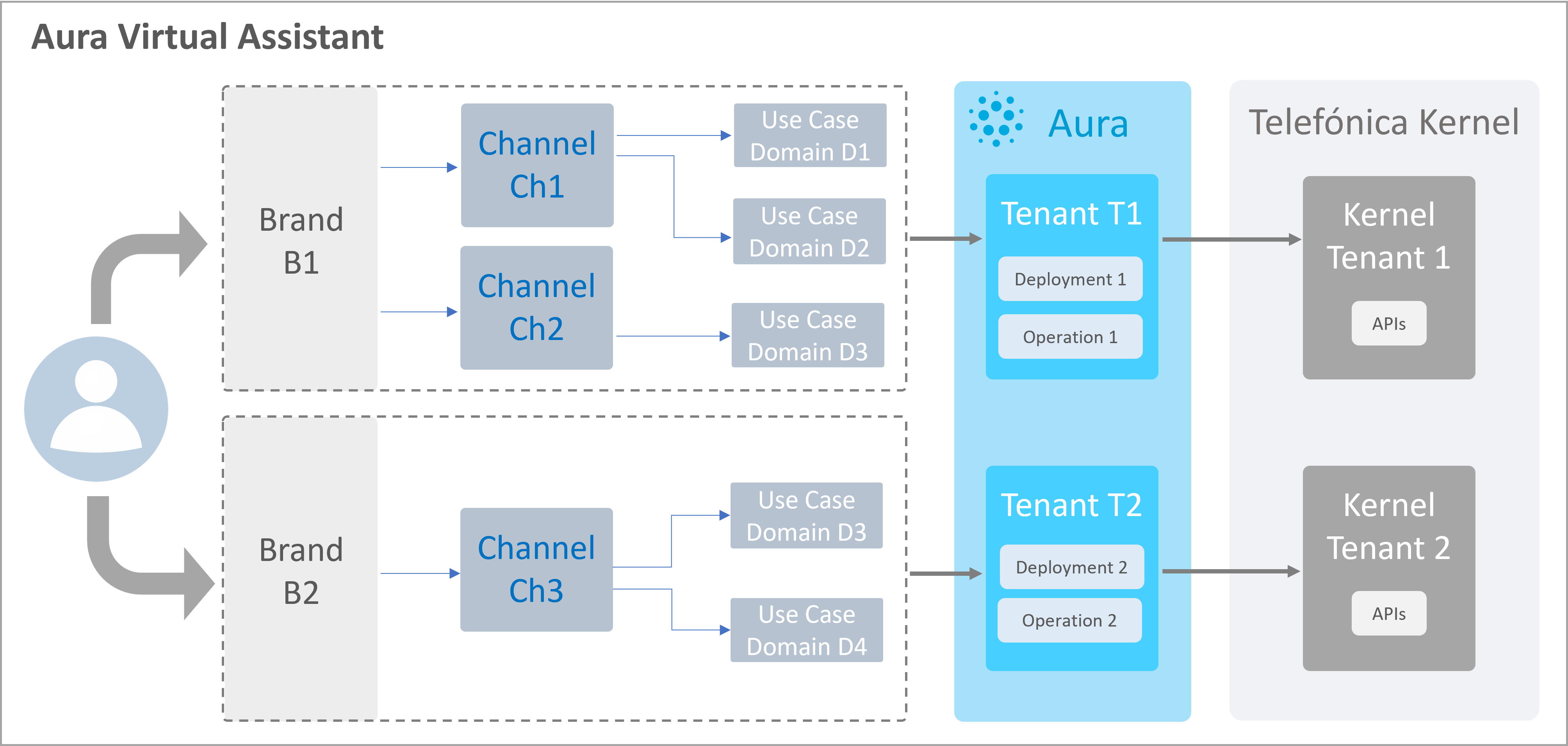
Overview of multitenant architecture in Aura Virtual Assistant
- Aura Virtual Assistant supports different brands
- Each brand is associated to several channels
- Each channel allows accessing to use cases in a specific domain
- Use cases in a specific brand are operated by a particular Aura tenant
- These use cases will be resolved using the Kernel tenant associated to this brand
An exception to this Aura Virtual Assistant behavior is for authentication. In this task, the authentication request enters firstly through a Kernel tenant, and once the user is authorized, it passes to the corresponding Aura tenant.
Comprehensive technical documents
Multitenant configuration in Aura installer
Aura installer: Multitenant configuration: Guidelines for the configuration of different tenants when several brands are available in the OB.
Descriptive documents and guidelines
Once the user accesses through a specific Telefónica brand, the technical behavior of the corresponding Aura tenant is similar to the one before the implementation of the multitenant architecture. Therefore, there are no specific descriptive documents or guidelines for the multitenant architecture.