Categories:
Generative AI capability
Overview of the Generative AI capability, encompassing the underlying technology, its application in ATRIA and the benefits derived from its use
Introduction to Generative AI
What is Generative AI?
Generative Artificial Intelligence is a subset of Machine Learning that focuses on the creation of new content, such as text, images, or music, based on patterns learned from large volumes of data.
This technology has advanced significantly in recent years, fueled by the development of Deep Learning models that can understand and replicate complex data structures.
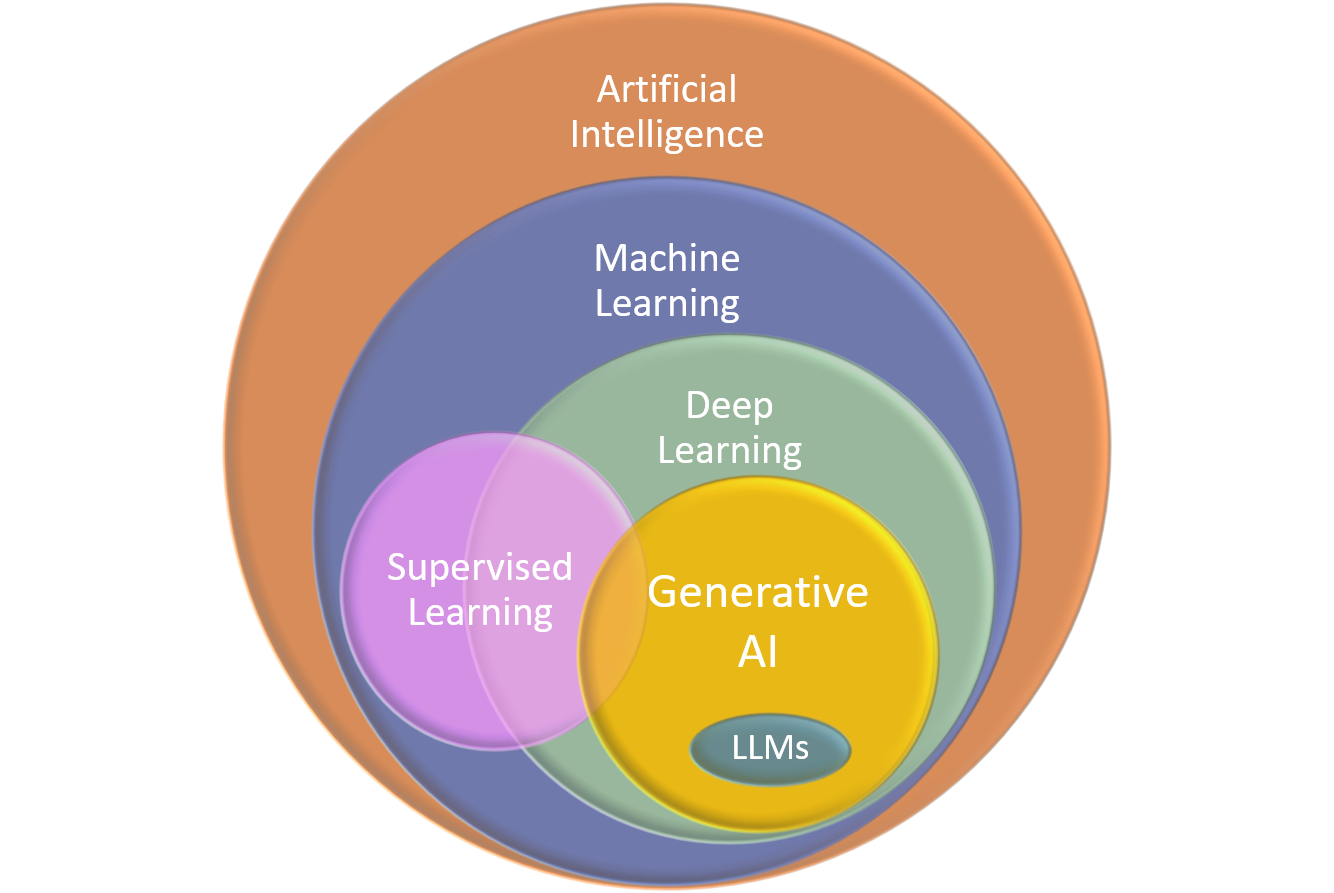
Figure 10. Generative AI technology
Below are the main steps in how Generative AI works:
-
Training: The model is fed with extensive datasets containing examples of the target content, allowing the system to identify patterns, structures and relationships among different elements.
-
Instruction input: The user provides an instruction or “prompt,” which can be a question, a topic, or any indication of what is expected from the model output.
-
Content generation: Based on the information obtained during training, the model applies complex algorithms to generate a relevant and coherent response or new content aligned with the user’s request.
-
Response delivery: The model presents the generated output to the user quickly and efficiently. It can be a text, an image, or any other type of content.
Within Generative AI, the Large Language Models (LLMs) are advanced AI models designed to understand and generate human-like text, typically trained on vast amounts of text data, enabling them to predict and produce coherent and appropriate text. They are the ones integrated into ATRIA.
Benefits and limitations
The main benefits from the use of Generative AI are summarized below:
- Creativity and Originality: Generative AI generates new and original content that can inspire creators.
- Efficiency: Generative AI automates content generation tasks, allowing humans to focus on more complex activities.
- Personalization: Generative AI generated content is tailored to the specific needs of users.
- Access to information: Generative AI provides quick answers to complex questions thanks to its extensive access to data.
Despite these advantages, Generative AI has certain limitations that led ATRIA to integrate other complementary technologies:
- Hallucinations: Generative AI can generate inaccurate responses that seem plausible, leading to misinformation.
- Temporal Limitations: Generative AI models are limited to the information available at the time of their last training, meaning they cannot access real-time or recent data updates.
Application of Generative AI in ATRIA
Generative AI is a key ATRIA capability provided by a predefined chain designed with the LLM/LMM Experiences Builder.
ATRIA enables the generation of experiences (use cases) to resolve users' requests expressed in natural language by supporting simple calls to AI models.
This is done through an easy integration of advanced Generative AI technologies while guaranteeing security and privacy in interactions.
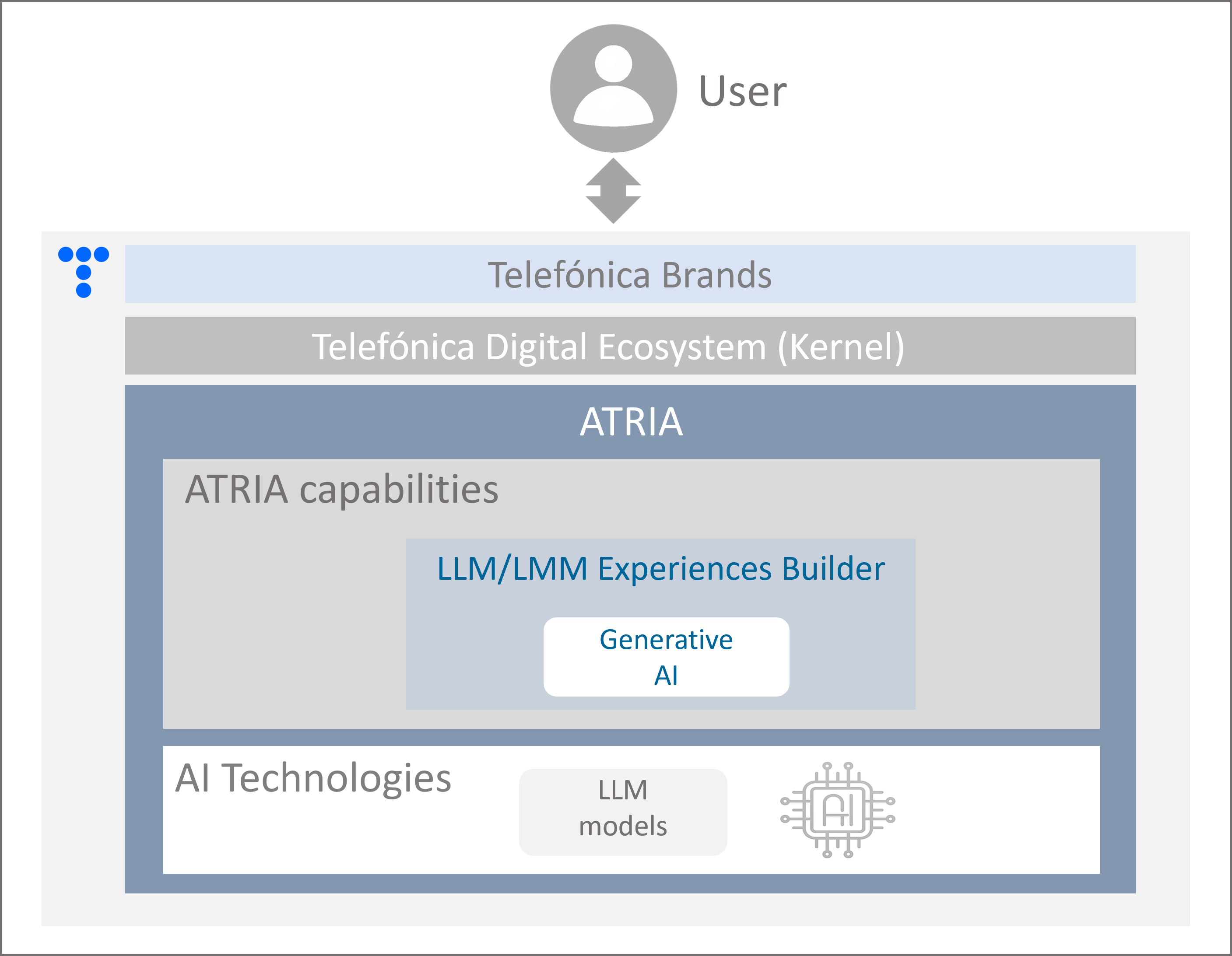
Figure 11. Generative AI in ATRIA
Example case
Imagine that our platform, ATRIA, operates like a restaurant with different chefs, each specialized in a unique approach to meeting customers' needs.
A traditional generative model can be compared to Chef Manuel, a chef who spent several years mastering in traditional Spanish cuisine.
Manuel’s expertise encompasses a wide range of recipes and cooking techniques, but some of his knowledge may be outdated since he hasn’t pursued further training in recent years.
When a customer requests for a nutritious and hearty meal, Manuel relies solely on his internal knowledge to prepare a classic dish: lentils with vegetables. He does not need to search for additional information because his prior expertise is sufficient to offer a consistent and reliable answer.
A traditional generative model operates like Manuel, generating responses based solely on the implicit knowledge learned during the model's training, without consulting external sources.
Interaction with ATRIA Generative AI
This service is accessible via API, enabling its consumption both from Aura Platform and any external application.
Current available models
The AI-driven models currently integrated into ATRIA are included here.
Functional overview
The use of this capability encompasses different stages:
-
When a user sends a request to ATRIA, it is sent to an auto-generative content generator, the one that best aligns with the use case considering different factors such as latencies, costs, etc.
-
Additionally, specific instructions upon which the model must base its response are also included. These instructions can be configured to meet specific channel-level business and experience requirements but, at the same time, to ensure that the provided responses retain the nuances of tone and personality that characterize Aura.
-
In addition, ATRIA provides a layer of security to avoid prompt injection, that is, to prevent misuse by third-party services that can create malicious prompts as inputs and cause the model to act in unintended ways.
For example, it can prevent a user from modifying the instructions on how the system should behave or the invalidation of instructions from a predefined block of the prompt (Aura personality), if contradictory instructions are given. -
The Generative AI model recognizes the request and generates the most appropriate response for it. This response is sent back to the user.
Benefits from the use of Generative AI in ATRIA
There are clear benefits derived from the integration of Generative AI in ATRIA:
Benefits for constructors
- It streamlines the use cases development process, since there is no need to generate specific responses or undergo specific trainings.
- Other types of experiences, not directly related to Aura, can be generated. For example: data analysis tasks, development of new products, etc.
Benefits for end-users
- Our customers’ satisfaction will increase, as Aura can offer enhanced understanding capabilities.
- Aura can incorporate new areas of interest for users in a more agile manner and explore new types of users for whom to develop services based on natural language recognition technologies.
- ATRIA interactions guarantee security and privacy for our users.
Generative feedback functionality
When testing how Generative AI/RAG capabilities work with the ATRIA web interface aura-manager, it is possible to use the feedback functionality to estimate the user’s satisfaction regarding the quality and appropriateness of the generated answer to her request. This can be done easily by clicking the thumbs-up or thumbs-down icons.