Categories:
NLP Apps capability
Overview of the NLP Apps capability, encompassing the underlying technology and its application in ATRIA
Introduction to NLP Apps technology
Within Natural language processing (NLP) technologies, NLP Apps refers to NLP pipelines (chains) that combine different technologies for language processing with several tools for combining them.
Currently, these technologies, both proprietary and third-party ones, are included in the Aura NLP component and can be categorized in the following groups:
-
Deterministic recognizers, such as Exact Match or Grammars.
-
Probabilistic recognizers, such as OpenAI embeddings: Semantic Search, that uses Azure OpenAI capabilities based on embeddings and Microsoft CLU.
-
Classifiers, from the traditional Domain Classifier to the embeddings-based Domain Classifier.
-
Entities recognition stages, Standard NER or Gazetteer NER, based on deterministic entity detection.
-
Other tools for executing different normalization tasks, connectors, adapters, etc.
The technical description of all the available NLP technologies in included in the document Components for NLP pipelines
Application of NLP Apps in ATRIA
ATRIA enables the generation of experiences (use cases) through the use of Aura cognitive capabilities as stand-alone NLP Apps for sending a request expressed in natural language and receiving back an accurate response without the need for a conversational bot.
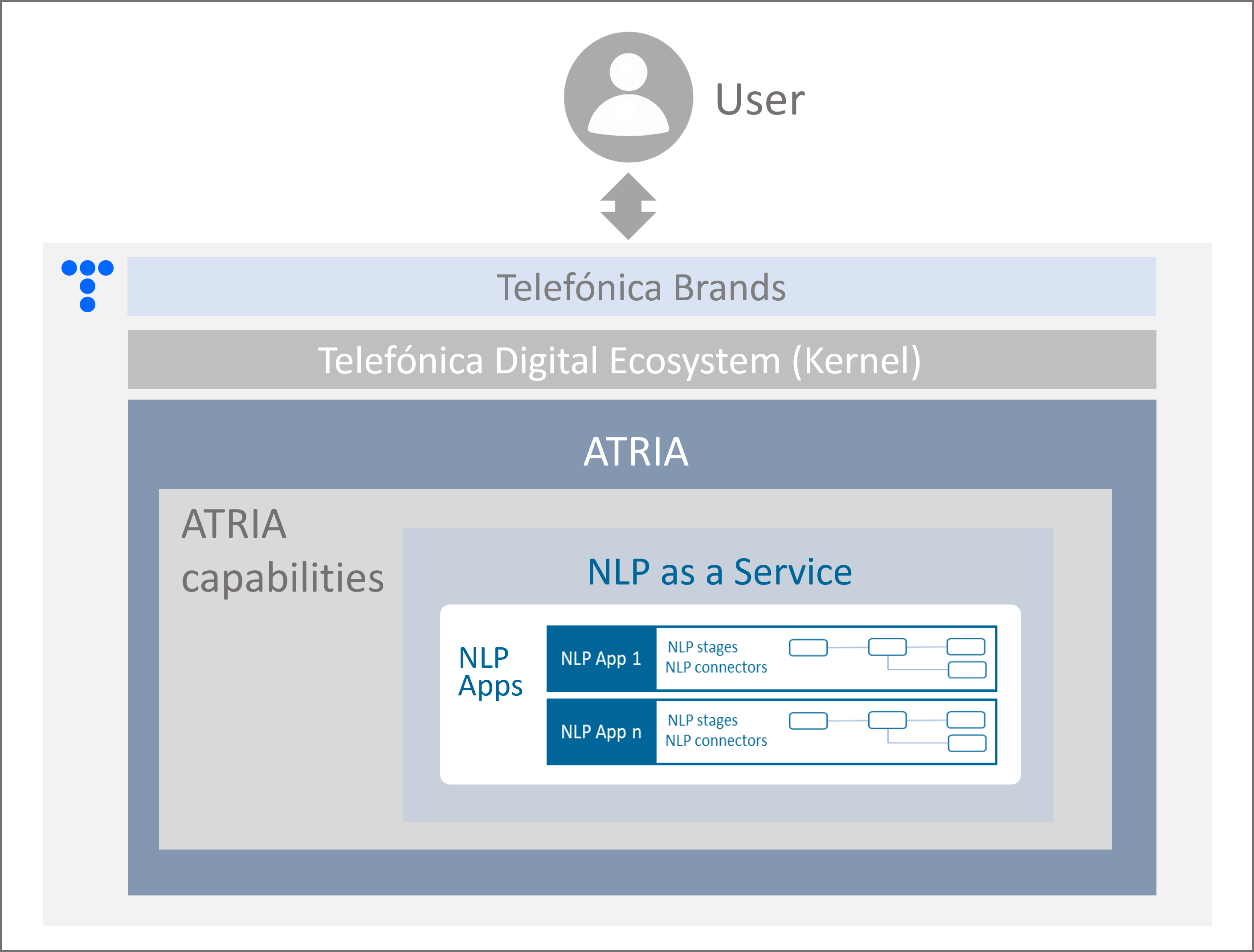
Figure 6. NLP Apps in ATRIA
Interaction with NLP Apps in ATRIA
This service is accessible via API, enabling its consumption both from Aura Platform or any external application.
Functional overview
A simple overview of the process is provided below:
-
A user sends a request to ATRIA, indicating which specific NLP App she wants to use for the recognition of the request. These Apps are available in Aura NLP, a module of Aura Cognitive Services in charge of processing and understanding human natural language.
-
The NLP technologies in the pre-selected specific App resolves the use case and generates a response.
-
The response is sent back to the user.