Categories:
Aura bot generic-dialog
Description of Aura bot generic-dialog, that allows managing several experiences for TV channels based on a simple configuration
Find here details regarding the global generic library and dialogs’ versions and the condition for a use case to be generic
Related documents
📄 Guidelines for the development of experiences through the generic-dialog
Introduction
The generic-dialog allows OBs to implement certain local use cases for Movistar Home, Movistar Plus and Set-top Box (STB) channels in an autonomous, agile and simple way with no code development, only by means of configuration.
Different versions compatible with channelData v1 and v3 are available:
- If your
channelDataversion is v1, then use generic-dialog-v1 - If your
channelDataversion is v3, then use generic-dialog-v3
Aura global generic-dialog
The generic-dialog responds to the intention of having a single dialog based on configuration that allows managing several intents whose behavior is similar.
Therefore, it allows the development of certain types of use cases in a simple and autonomous way, with no associated code development and simply by means of configuration.
The global generic-dialog file, generic-dialog.ts includes the logic for the use case execution, where configuration is recovered and the output message is generated with the defined parameters.
Besides this global generic-dialog, there are several plugins based on the same dialog, all of them working as the global one and with similar code. In this framework, each OB have a specific generic-dialog in its corresponding library generic-[OB]/ which must be used when developing a local use case.
The global library that includes the generic dialog is named generic and has been designed for the management of different types of dialogs.
You can find it here.
Conditions for a use case to be generic
In order to consider a use case as part of the generic-dialog, it must fulfil these conditions:
✅ Local use cases developed from scratch by the OBs.
✅ Use cases with intents that can be managed by Movistar Plus, Movistar Home or Set-Top-Box (STB) channels.
✅ Dialog with only one interaction with the user: only one message from the user and one response from the bot are allowed. For example: greetings dialog.
✅ There is a direct transformation from intent to action (you may or may not call the API Movistar Resolution for this purpose). For example: tv-remote-actions use cases).
✅ Use cases that require the conversion of input parameters through a function to get the correct payload. For example: conversion on entities. For example: move_forward.
✅ Currently, only one text response is allowed:
settings.locale.successwhen all works fine.settings.locale.errorwhen something goes wrong.- Also, the text can be set in the response from the resolution API but, if required for example a variable text depending on the response of the API or the recognized entity, then developers must create another dialog.
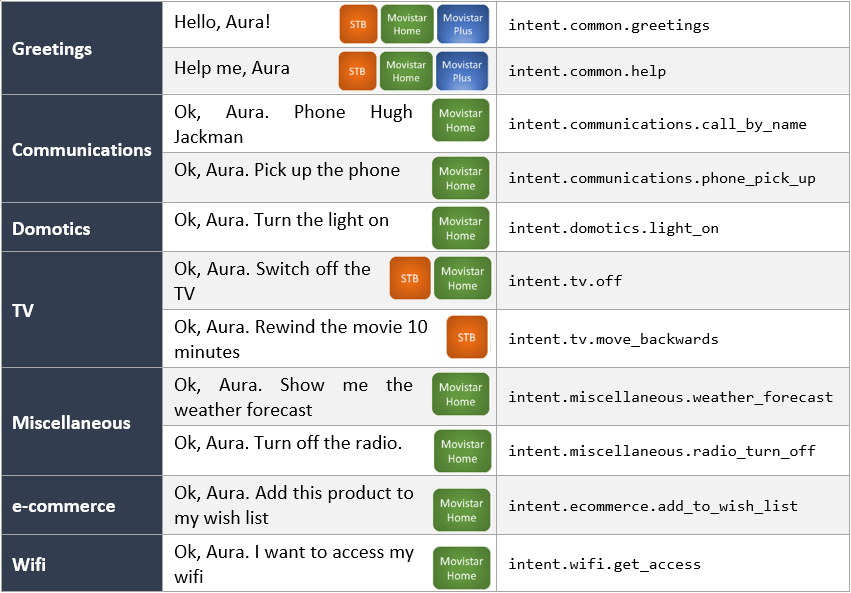
Merely as examples of the potential of aura-bot generic dialog, below you can find different use cases for the channels Movistar Plus, Movistar Home or STB channels that can be developed through it. Use them as a reference for developing your own local experiences!