Categories:
Aura Virtual Assistant functional description
Discover in this document the fundamentals of Aura Virtual Assistant architecture from a functional point of view and a high-level overview of its main components
Foundation: Microsoft skills architecture
Aura architecture is conceived as a multi-bot system based on Microsoft Bot Framework skills architecture.
In this framework, the architecture is composed of a root bot, that can call one or more skill bots, which are specific to a knowledge area or topic.
The user interacts directly with the root bot, and it delegates the conversational logic to a skill to provide the user with the intended service or response.
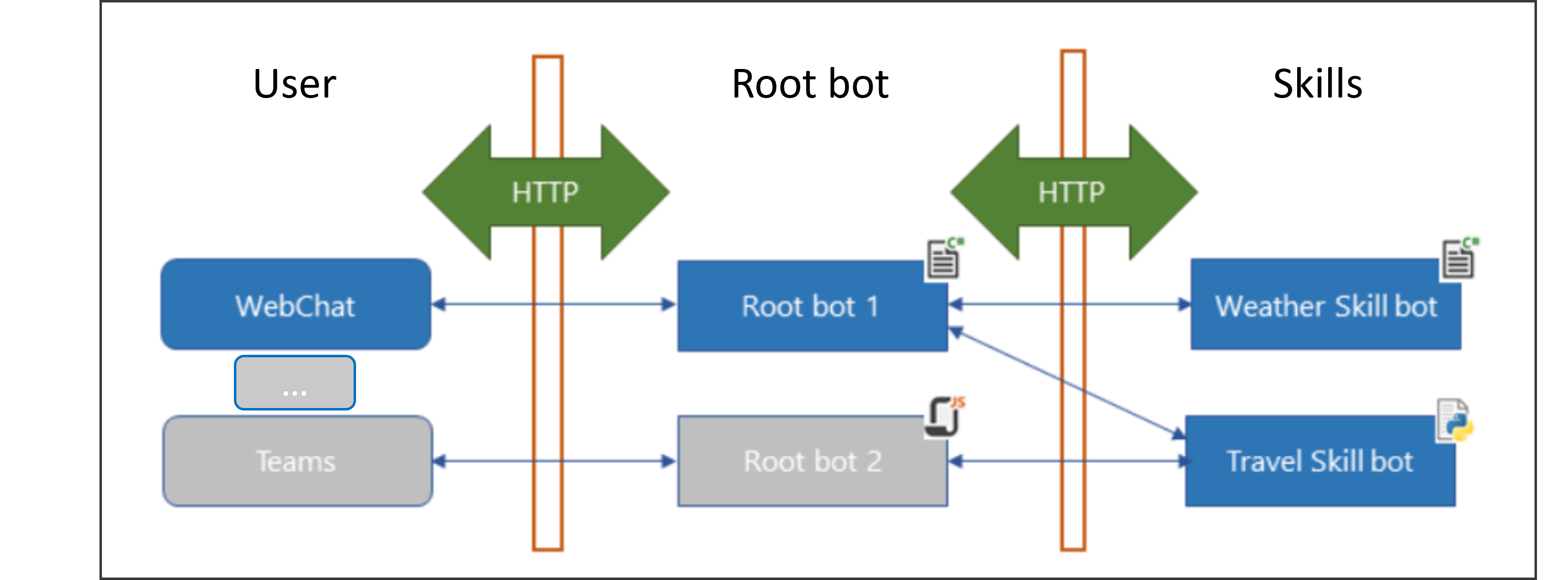
Figure 3. Microsoft skills
Access Microsoft Skills documentation.
Aura Assistant functional overview
Starting from the functional overview flowchart (Figure 2), the current section zooms in and shows a deeper detail of the functional operation of Aura Virtual Assistant.
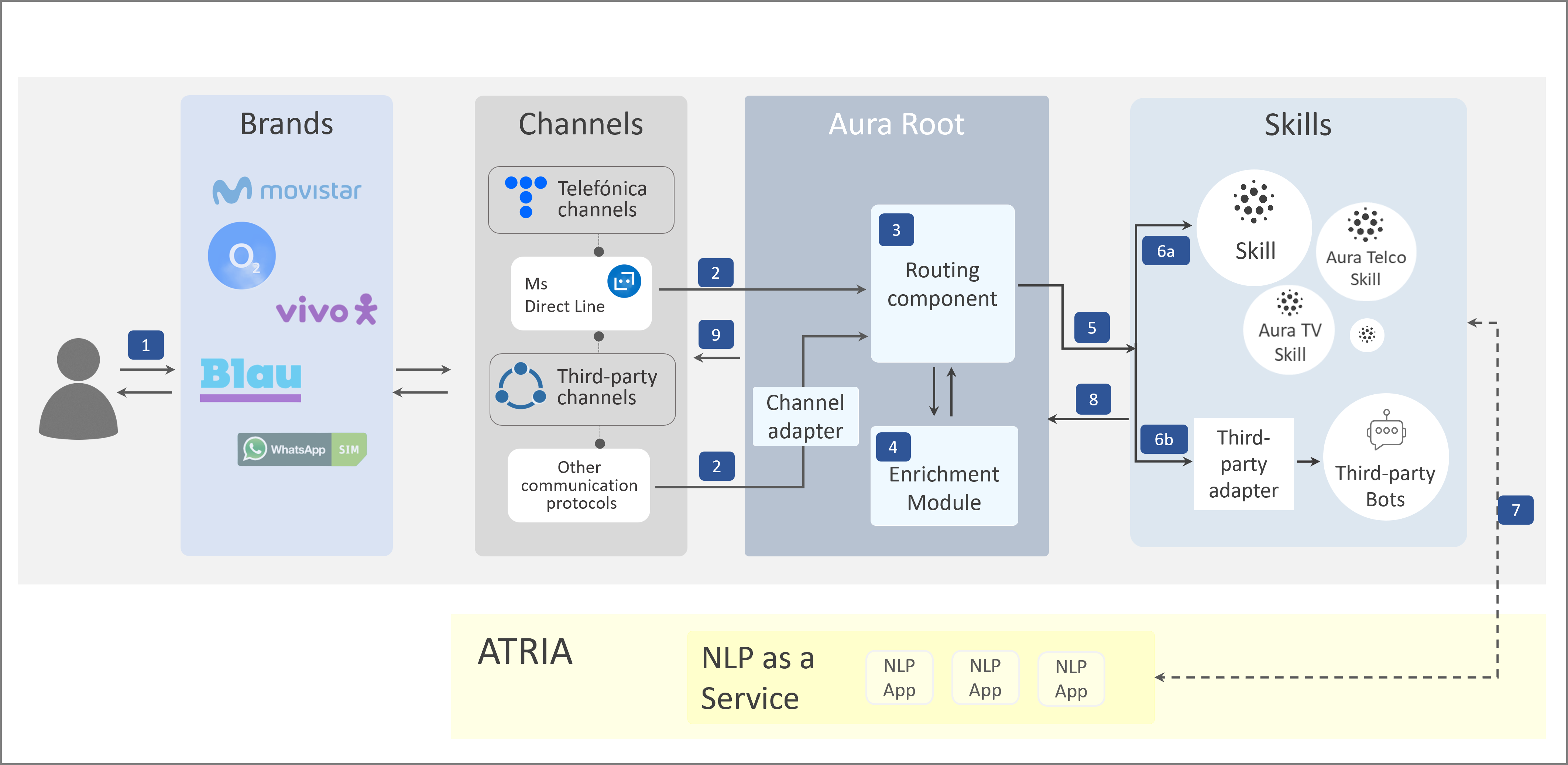 Figure 4. Aura Virtual Assistant functional operation
-
The user accesses a specific Telefónica brand and sends a request to Aura through a channel.
-
The channel connects to Aura Root.
Two scenarios arise here:- If the channel “speaks” a language Aura understands, that is, it supports Direct Line protocol: direct connection.
- If the channel “does not speak” a language Aura understands: the incoming request must be converted into a standard Aura message through an adapter.
-
Aura Root makes the decision about what is the best skill (bot) to answer the user’s request in a routing component.
-
Optionally, it is possible to add additional information to the request through an enrichment module, with data coming from Aura context, algorithms, analytical models, insights, etc.
-
Aura Root sends the request to a specific skill, depending on the selected domain.
-
The specific skill (domain-bot) routed by Aura Root receives the request and handles it. At this stage, two scenarios can arise:
- 6.a. The skill receives the request in Direct Line format.
- 6.b. If the routed bot is not part of the Microsoft ecosystem (third-party bots), the request must be transformed through a third-party adapter to be understood by the bot (and the other way around with answers).
Strictly speaking these adapters are not part of Aura Root and could be integrated through different strategies by the OBs. For instance, the conversion could be performed in a specific skill connected to the third-party bot.
-
The skill calls NLP as a Service capability in ATRIA for the recognition of the user’s intention and entities.
- Currently, aura-bot as a skill works as in the previous architecture, calling Aura NLP for recognition purposes.
-
The response to the user’s request is built and sent back to Aura Root.
-
Aura Root provides the answer back to the channel. If required, the channel adapter converts again the Aura message to the format compatible with the channel.
Take into account that the current document only shows a functional representation in order to make the new architecture more understandable for readers. The underlying technical components and processes are explained in the documents:
- Aura Virtual Assistant development architecture and operation
- Aura Virtual Assistant technical components
- Aura Virtual Assistant technical guidelines