Categories:
Aura Complex Logic Framework
Aura Complex Logic Framework (CLF) is the component in charge of the resolution of complex use cases in Aura.
Find in the current documents the description of this component, its architecture, components and processes.
Aura Virtual Assistant component
What’s Aura Complex Logic Framework?
The resolution of complex experiences in Aura requires that, once the user’s intent has been recognized by Aura NLP (Natural Language Processing), the dialog triggered by this intent summons the Complex Logic Framework (CLF) that allows developers to improve use cases, creating and integrating plugins in Aura Platform to be consumed by the aura-bot dialogs and extend their logic for the resolution of complex users’ requests.
Therefore, it will be a key Aura component for the resolution of use cases, for example, for TV platformization.
Throughout the CLF documentation, you will discover:
- CLF architecture and components: Description of CLF architecture and main components.
- CLF configuration: General configuration and configuration of plugins.
- CLF files: Description of Aura CLF files and libraries.
- CLF global plugins: CLF global plugins developed by Aura Global Team.
- CLF API definition: The Complex Logic Framework is based on Python plugins and is able to access Kernel APIs and other internal APIs exposed by other internal Aura components. Check here the main swagger for all the CLF plugins.
Interaction of CLF with Aura
The interaction of the Complex Logic Framework with Aura is shown in the following figure and explained below:
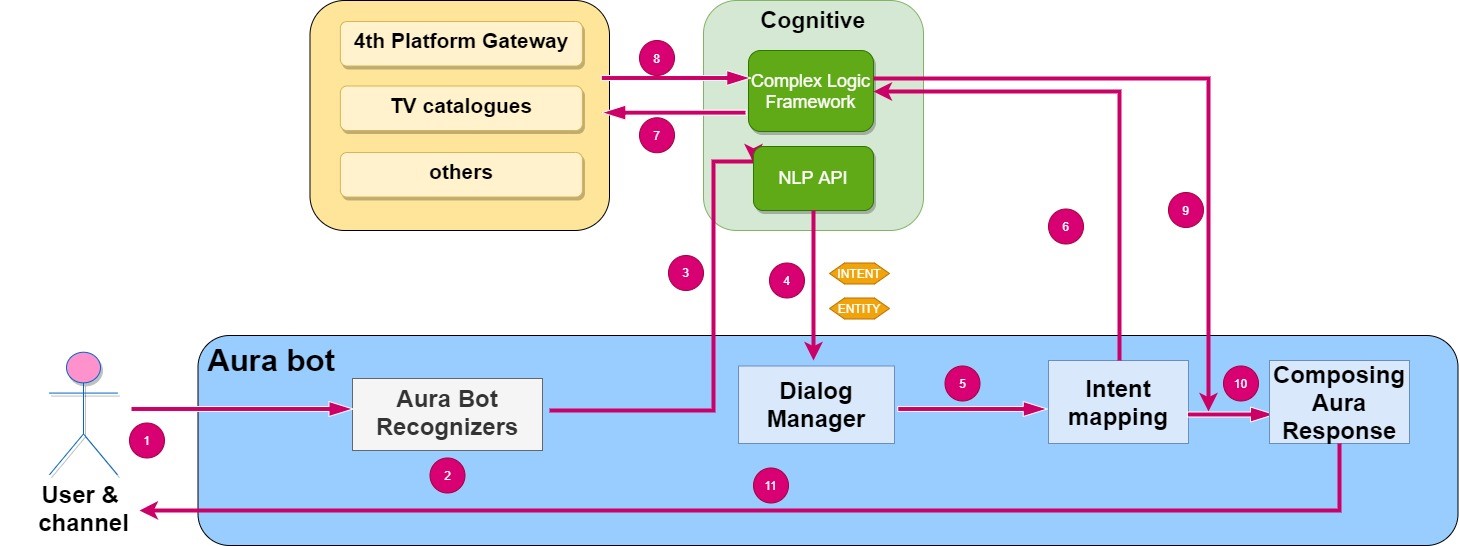
- An Aura user asks for a service/request (utterance) through a specific channel.
- aura-bot receives the user´s request. Firstly, aura-bot recognizers come into play.
- The corresponding recognizer summons Aura NLP for the recognition of the user’s utterance (in certain situations corresponding to auraCommands, the user’s request is understood directly by the bot).
- NLP returns the intent and associated entities in the user’s utterance.
- The recognized intent triggers a specific aura-bot dialog, in charge of the logic for the resolution of the use case.
- The dialog recognizes the complexity of the use case and, if required, summons the Complex Logic Framework.
Depending on the type of plugins, the bot will call a different API.
After that, the Complex Logic Framework selects the appropriate plugin among the ones existing on this specific type, based on the identified intent (mapping the intent with the plugin). - The plugin executes the programmed tasks and calls different modules (Aura’s internal data, Kernel data, external databases, etc.) in order to fetch the information.
- The Complex Logic Framework receives the required data.
- The information is sent back to aura-bot.
- aura-bot composes the response to the user’s request.
- The response is provided to the user.