Categories:
Aura Analytics 1.1. architecture
Technical architecture of Aura Analytics 1.1.
Architecture description
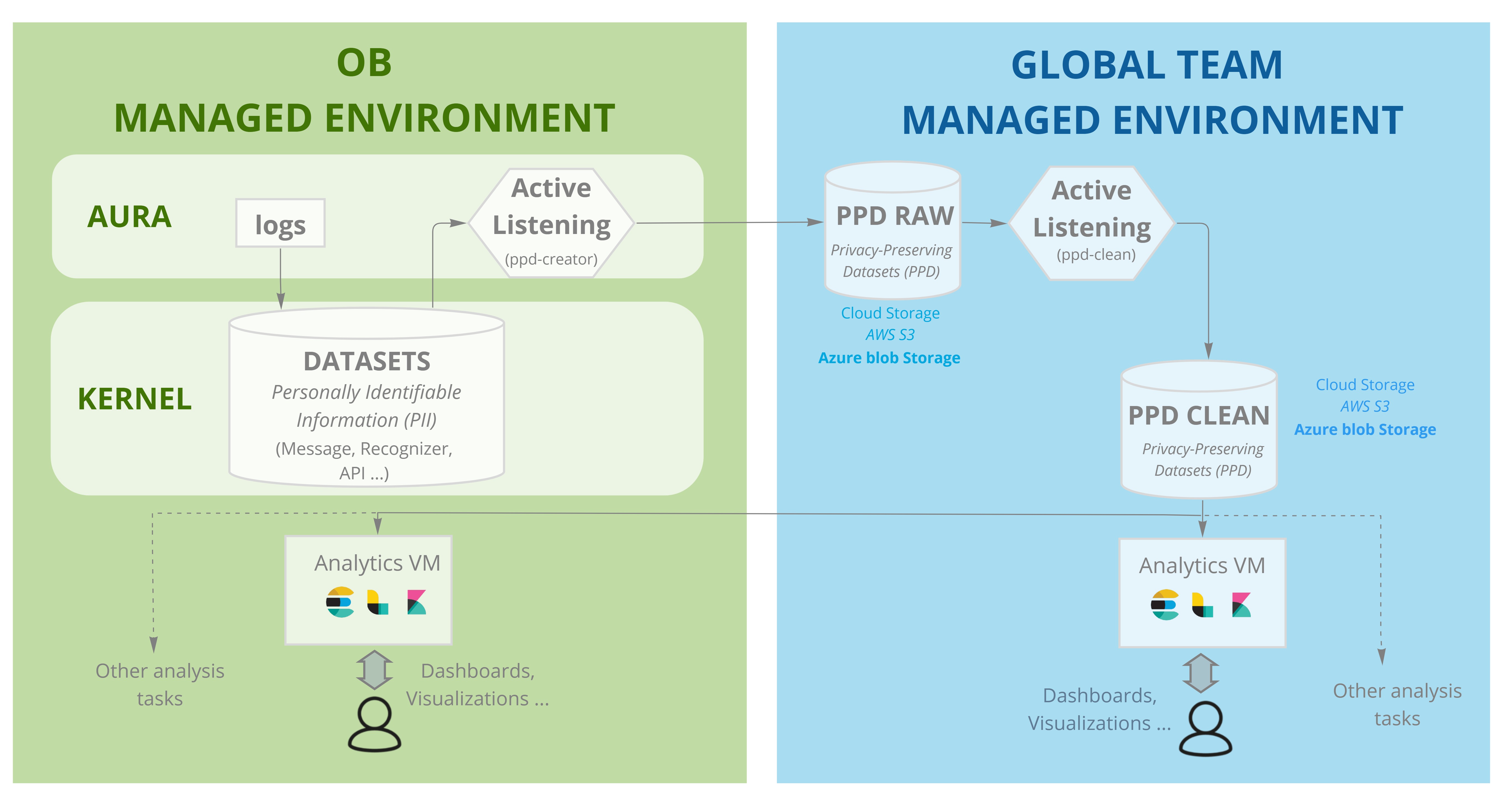
The following figure shows a full overview of Aura Analytics Dashboard architecture and operation, which is also described below:
-
Aura logs generated in local instance are converted to datasets and transferred to local Kernel via the standard procedure and with the established frequency (typically, daily).
-
Once there, the “Active listening” process flow fires up daily. Through a specialized process that runs on an Aura local instance and with access to the stored datasets in the Kernel local storage space:
- PII (Personally Identifiable Information) is removed or encrypted.
- The result is transferred to a bucket/blob set up for this task and managed by Global Aura team.
- Here, the PPDs (Privacy-Preserving Datasets) are created. Currently, only
MESSAGE,RECOGNIZERand API datasets are involved in this process.
In order to convert PII data to PPD, every field in these datasets can be:
- a. Not transferred.
- b. Pseudo-anonymized. In this situation, the field is transformed through a cryptographic hashing process using a secret set up by the OB.
- c. Anonymized fragments of the field (e.g., credit card number, email, etc.). The field is processed to detect specific patterns and replaces them with a specific tag (
idemail,idpassport, etc.). The list of anonymization strings is agreed with each OB. - d. Transferred as is.
-
After that, the Raw PPD Datasets stored in bucket/blog managed by the Global Team are processed generating clean PPD Datasets in order to adapt them to the analytics tools.
-
From that space, the clean PPD Datasets can be:
-
Accessed by the Aura Global Team that use them for several tasks, with the purpose of evaluating Aura quality and taking the best decisions regarding to product evolution:
- Perform analytics on Aura behavior and prototype Analytics Dashboard features
- Improve Aura Platform capabilities (e.g., adapting machine learning models)
-
Accessed by a Local Aura Team, ingesting the data to a dedicated server managed by the OB with analytics and data visualization capabilities. In order to do that, the Aura Global Team provides a component with the ELK (elasticsearch, logstash & kibana) preconfigured with a set of dashboards that can be deployed and adapted by the OB team.
All the code involved in this process can be found in Github. Particularly:
-
Utterance anonymization (agreed individually for ES and UK)