This is the multi-page printable view of this section.
Click here to print.
Return to the regular view of this page.
Aura Complex Logic Framework
Aura Complex Logic Framework
Aura Complex Logic Framework (CLF) is the component in charge of the resolution of complex use cases in Aura.
Find in the current documents the description of this component, its architecture, components and processes.
Aura Virtual Assistant component
What’s Aura Complex Logic Framework?
The resolution of complex experiences in Aura requires that, once the user’s intent has been recognized by Aura NLP (Natural Language Processing), the dialog triggered by this intent summons the Complex Logic Framework (CLF) that allows developers to improve use cases, creating and integrating plugins in Aura Platform to be consumed by the aura-bot dialogs and extend their logic for the resolution of complex users’ requests.
Therefore, it will be a key Aura component for the resolution of use cases, for example, for TV platformization.
Throughout the CLF documentation, you will discover:
- CLF architecture and components: Description of CLF architecture and main components.
- CLF configuration: General configuration and configuration of plugins.
- CLF files: Description of Aura CLF files and libraries.
- CLF global plugins: CLF global plugins developed by Aura Global Team.
- CLF API definition: The Complex Logic Framework is based on Python plugins and is able to access Kernel APIs and other internal APIs exposed by other internal Aura components. Check here the main swagger for all the CLF plugins.
Interaction of CLF with Aura
The interaction of the Complex Logic Framework with Aura is shown in the following figure and explained below:
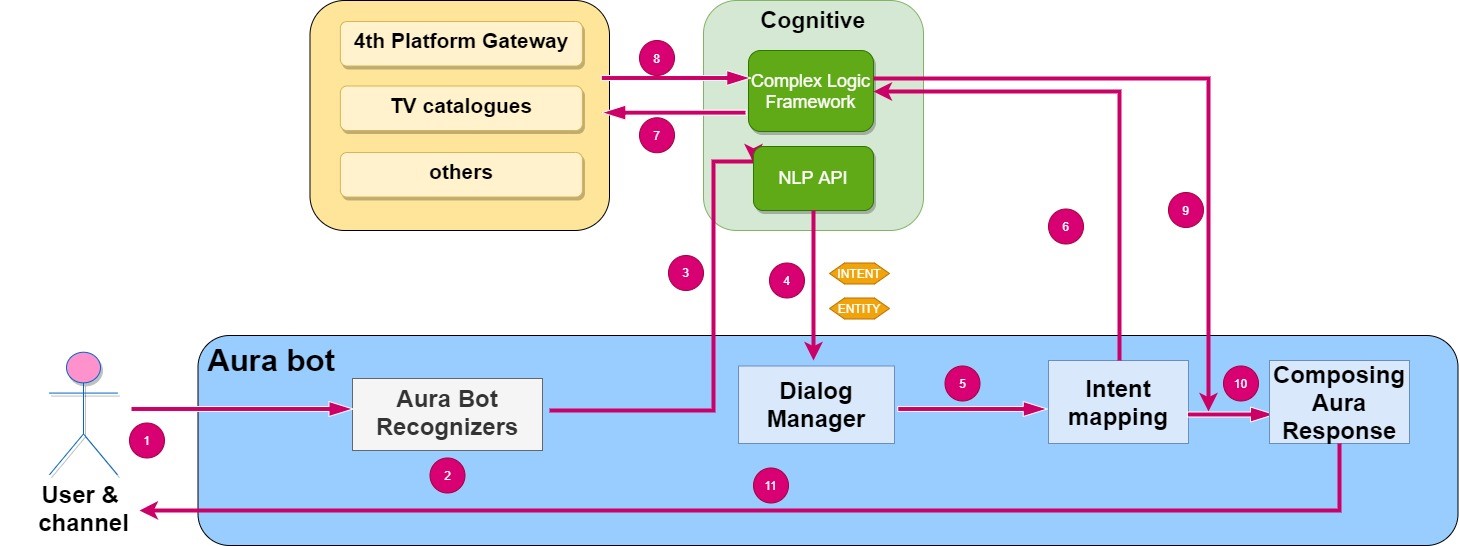
- An Aura user asks for a service/request (utterance) through a specific channel.
- aura-bot receives the user´s request. Firstly, aura-bot recognizers come into play.
- The corresponding recognizer summons Aura NLP for the recognition of the user’s utterance (in certain situations corresponding to auraCommands, the user’s request is understood directly by the bot).
- NLP returns the intent and associated entities in the user’s utterance.
- The recognized intent triggers a specific aura-bot dialog, in charge of the logic for the resolution of the use case.
- The dialog recognizes the complexity of the use case and, if required, summons the Complex Logic Framework.
Depending on the type of plugins, the bot will call a different API.
After that, the Complex Logic Framework selects the appropriate plugin among the ones existing on this specific type, based on the identified intent (mapping the intent with the plugin).
- The plugin executes the programmed tasks and calls different modules (Aura’s internal data, Kernel data, external databases, etc.) in order to fetch the information.
- The Complex Logic Framework receives the required data.
- The information is sent back to aura-bot.
- aura-bot composes the response to the user’s request.
- The response is provided to the user.
1 - Architecture and components
Aura Complex Logic Framework architecture and components
Architecture and main components that you should handle when working over Aura Complex Logic Framework
CLF architecture
Aura Complex Logic Framework is a docker container, meaning that it is configured as a lightweight, stand-alone, executable package of software that includes all the required elements to run an application.
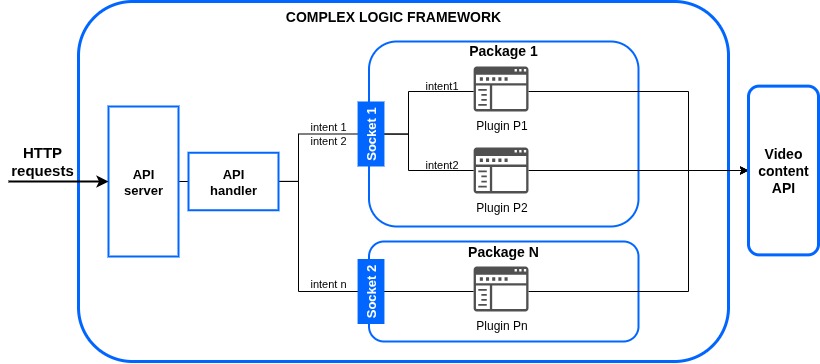
The Complex Logic Framework architecture is schematically shown in the following figure, containing different elements described in the succeeding sections.
CLF main components
Sandbox
A sandbox is an isolated testing environment that enables users to run programs or execute files without affecting the application, system or platform on which they run and to test new programming code.
Plugins
Plugins in Aura Complex Logic Framework are components that add a specific feature to an existing computer program, enabling its customization.
The role of plugins within the Complex Logic Framework is to receive data, make the required computations and return an adequate response to the handler.
CLF manages different types of plugins, which are encapsulated in the sandbox. Moreover, it contains several global plugins, but it is possible for developers to add custom ones.
Some key features of CLF plugins are defined below:
-
Architecture allows each package of plugins to be deployed in its own environment: it is possible to have an isolated container deployed in an independent way containing all the plugins of a specific package (for instance, global plugins).
-
Each package is isolated by being run as a different process by a unique user with randomized name. The rationale behind this is to provide an isolated sandbox to make sure no package of plugins is a security risk. Thereby, each user has limited privileges and computational resources (memory, file descriptors and CPU time) and only runs one process for package.
-
The running packages can only receive data from a socket, and the appropriate plugin is then executed depending on both the plugin type and the intent contained in the data. The API handler is in charge of forwarding the data to the package, acting as a proxy, but it also checks the requests and transforms the responses back.
To ease working with this architecture, packages, users and sockets have the same random name. This name also appears in the information and error log files.
-
OBs can develop their own custom plugins in the Aura Complex Logic Global repository, with each plugin implemented as a class that inherits from PluginBase and overwrites run method. This method receives the request data and contains the logic of the plugin. It must also generate a response that will be returned to the API handler.
When a request is performed, depending on the intent, the request data will be forwarded to the corresponding plugin automatically. Note that two intents can trigger the same plugin but it is not possible to trigger two plugins with the same intent.
-
Each package of plugins is watched by a supervisor. If the package process crashes, it will be restarted automatically by supervisor. The causes of abrupt exit could be excessive consumption of resources (CPU time, memory or file descriptors) or plugin internal malfunction.
Stub
A stub, in the context of distributed computing, is a piece of code that is used to convert parameters during a remote procedure call (RPC). An RPC allows a client computer to remotely call procedures on a server computer.
The parameters used in a function call have to be converted because the client and server computers use different address spaces. Stubs perform this conversion so that the remote server computer perceives the RPC as a local function call.
API server
API server is the process that listens for requests. This API server is based on the cognitive API package and, in this case, is configured to run the Complex Logic module.
HTTP requests will be passed to the package API handlers according to the CLF configuration.
It is also important to mention that API server process is watched by supervisor (meaning that it is fault-tolerant).
API handler
In Aura Complex Logic Framework, API handlers are classes that inherit from BaseComplexLogicAPIHandler. They are responsible for dealing with HTTP requests through the following methods:
- Checking the request is valid.
- Checking that the response is in the correct format.
- Making a new request to the corresponding package process, which contains a group of plugins.
The first two items are implemented by the declaration of schemas that define the query request and the response. Plugin API handlers are only responsible for defining which request schema is accepted and which response is valid (also by using a schema).
The request to a specific package is made automatically by the system as long as the specific intent that summons the trigger is recognized. The configuration is described in plugins configuration.
API plugin
API plugin is an internal component based on the cognitive API package. It exposes the plugins contained in a package.
Kernel is the database where Telefónica stores all the data of its customers in a safe and reliable way, allowing users to control their data at the same time.
These data can be consulted through a Kernel API with the necessary permissions. From the Complex Logic Framework, the only way to access Kernel is through our connectors. The connectors are used, for example, to obtain customer invoices or offer the catalog of devices and services.
These connectors provide total security in order to avoid problems of wrong, malicious or not careful use by third party developers. For this purpose, prior to any request to Kernel, a check of the required permits is made.
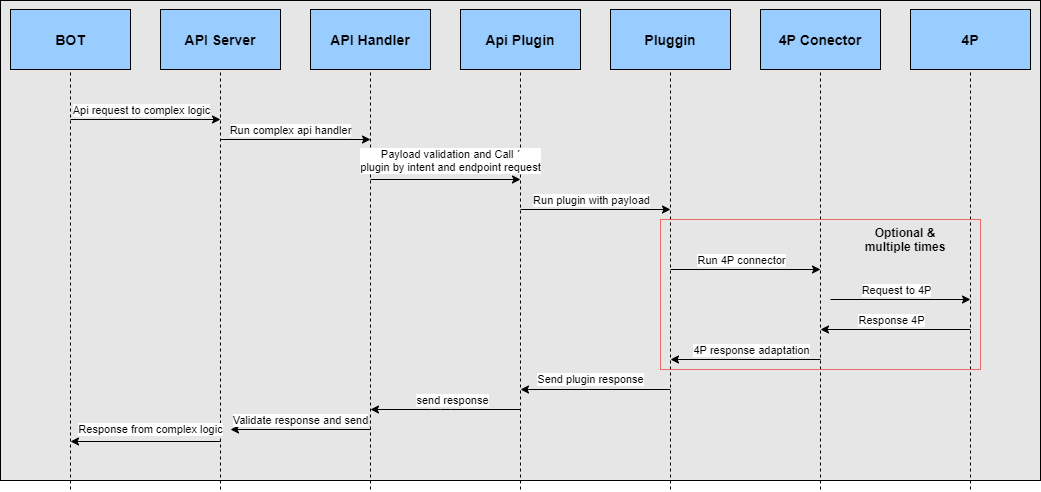
CLF Sequence diagram
The following sequence diagram shows the functional flow of the Complex Logic Framework, starting with the request from aura-bot to the Complex Logic module.
2 - Configuration
Aura Complex Logic Framework configuration
Description of the configuration required by the Complex Logic Framework, both operational configuration and configuration of plugins
Introduction
The configuration of the Complex Logic Framework has two different purposes, each of them supported by a configuration file:
General operational configuration
The file bootstrap.cfg contains the Complex Logic Framework operational config sections. This file is included in the CLF repository, within the folder:
~/aura-complex-logic-[country_code]/config/etc/bootstrap.cfg
⚠️ OBs must not modify these fields. If any modification is required, it must be adjusted after approval by the Aura Platform Team
The file follows the general structure shown hereunder:
[logging]
handlers = { . . . }
loggers = { . . . }
root = { . . . }
Logging
[logging]
handlers = {
      'hdl1':{
         'class':'logging.StreamHandler',
         'formatter':'console',
         'level': 'DEBUG'
      },
      'hdl2':{
         'class':'logging.StreamHandler',
         'formatter': 'simple',
         'level': 'DEBUG'
      }
   }
loggers = {
      'plugins': {
         'level': 'DEBUG',
         'handlers':[
            'hdl1'
         ],
         'filters': [],
         'propagate': False
      }
    }
root = {
      'level': 'DEBUG',
      'handlers':[
         'hdl2'
      ]
    }
The main fields are explained below. However, for more details, developers are kindly requested to read the Python logging documentation.
-
handlers: This field configures a dictionary with different logging handlers. Each key is the name of a handler, and is composed of the following parameters:
class: It is configured with Python logging handlers (See Python documentation).formatter: It configures the format of logs. It must be filled with the labels json, string, console or simple.level: It is referred to the level of the logging event. It must be filled with the labels INFO, ERROR, WARN or DEBUG.
-
loggers: The corresponding value is a Python dictionary in which each key is a logger name and each value is a dictionary that describes how to configure the corresponding Logger instance:
level (optional parameter): Level of the logger.handlers (optional parameter): List of IDs of the handlers for this logger.filters (optional parameter): List of IDs of the filters for this logger.
-
root: This field includes the configuration for the root logger.
level (optional parameter): Level of the logger.handlers (optional parameter): List of IDs of the handlers for this logger.
Plugins Configuration
The file complex_logic.json includes the specific configuration for each plugin. It is included in the following path of the CLF repository:
~/aura-complex-logic-[country_code]/config/plugins/complex_logic.json
⚠️ OBs must not modify these files. If any modification is required, it must be adjusted after approval by the Aura Platform Team
{
     "aura_clf_XX.plugins.plugin_1_name.plugin_1_class_name": {
         "config": {
             "sound_disabled_channels": ["channel_1", "channel_2"],
         }
     },
     ...
     "aura_clf_XX.plugins.plugin_N_name.plugin_N_class_name": {}
}
Each plugin requires a specific configuration. This will be defined in a JSON file with the following structure:
- Class path: Path and identifier for the plugin.
- Open dictionary including the specific configuration of the plugin.
Enabling/disabling sound responses
Within the configuration dictionary of each plugin, you can include the sound_disabled_channels field to specify in which channels sound responses (both positive and negative) should be disabled for that plugin. This field must be a list of channel prefixes.
For example, if a channel prefix is included in this list, the plugin will not play any sound in its responses when the interaction occurs through that channel.
Currently, the configuration added in this file is not included in the production phase, therefore this file should only list the Plugins class path and keep an empty dictionary as configuration.
Disabling contingency or fallback modes for tv search use case
For the tv search use case, in the configuration dictionary of the plugin aura_clf_video.plugins.tv_search_plugin.TvSearchPlugin, you can include the contingency_disabled_channels field to specify if the contingency or fallback search mode is disabled for a specific channel. This field must be a list of channel prefixes.
{
    "aura_clf_video.plugins.tv_search_plugin.TvSearchPlugin": {
        "config": {
            "contingency_disabled_channels": ["channel_1", "channel_2"],
        }
    },
    ...
}
3 - Files and libraries
Aura Complex Logic Framework files and libraries
Description of the files and libraries that integrate the Complex Logic Framework
requirements.txt file
This file contains Python module dependencies. By default, it includes two own libraries:
And other external ones used in the testing and verification stages:
flake8-htmlPylintpytest-pylintpytest-html
It is possible to include new dependencies in this file if required for the development of new plugins.
auracog-lib
auracog-lib library is a Python package containing a few basic classes & modules intended as helpers for Aura Cognitive applications, specifically:
- Configuration: it contains
AuConfig, wrapper for the standard Python ConfigParser with certain added functionality.
- Logging: it contains
LoggerWrapper, wrapper for the standard Python logging with certain added functionality.
- Testing: it contains functionality used in test development.
auracog-plugins-lib
auracog-plugins-lib contains the necessary utilities for all the plugins, such as validators and metrics used in verification and performance scripts or plugin_base, the base class of all the plugins.
plugin_base.py file
This is an essential internal file in Aura Complex Logic Framework for its proper performance. This file contains the base class PluginBase, from which all the plugins that are developed will inherit.
All the plugins developed will be initialized with a configuration and a logger that will be passed to them as a parameter and they will have to necessarily develop an asynchronous run method. The run method is the main method of the plugin and will develop the activity for which the plugin has been designed. This method receives data, a dict with the JSON request as a parameter and it will return the JSON response as a dict.
It is also possible to use other auxiliary methods if developers consider it.
from typing import Dict

from auracog_lib.aura_logging import logger_wrapper
from auracog_lib.code_utilities.type_hints_utilities import TypeHintsUtilitie
from auracog_lib.utils.exception import AuraAbstractException


class PluginBase:

    def __init__(self, cfg: Dict, log: logger_wrapper.LoggerWrapper):
        """
        Init method. No overload is required.

        :param cfg: a dict with the configuration for plugins.
        :param log: a logger object that implements the usual info, debug and error methods.
        """
        self.cfg = cfg
        self.log = log

    async def run(self, data: TypeHintsUtilities.Json) -> TypeHintsUtilities.Json:
        """
        Overload this methods in your custom plugins.

        :param data: A dict with the JSON request.
        :return: The JSON response that will be returned as a dict.
        """
        raise AuraAbstractException
4 - Global plugins
Aura Complex Logic Framework global plugins
Global plugins developed in Aura Complex Logic Framework
Introduction
Plugins in Aura Complex Logic framework are components that add a specific feature, thus enabling its customization. They receive data, make the required computations and return an adequate response to the handler
Aura CLF contains several global plugins, but it is possible for developers to add custom ones in the Aura Complex Logic global repository.
This section describes the current catalog of Aura CLF global plugins developed by Aura Global Team. Currently, CLF only contains video plugins, suitable for TV use cases.
Aura CLF video plugins
This is a swagger whose role is the validation of the input for video plugins. It includes a sub-section for each plugin, corresponding to a specific TV use case.
The purpose of this swagger is to show the description models and examples for possible video plugin requests and responses.
ℹ️ Check the multiple example response of plugins: Success, Error invalid request, etc.
Access here to Input validation video plugin
TV search plugin
Plugin for the TV search use case:
TV display plugin
Plugin for the TV display use case:
TV content get info plugin
Plugin for the TV content get info use case:
Plugin for the TV vod epg information use case:
5 - API definition
Aura Complex Logic API
Complex Logic Framework API swagger documentation, which is the main swagger for all CLF plugins
Download swagger file