This is the multi-page printable view of this section. Click here to print.

Return to the regular view of this page.

NLP as a Service

NLP as a Service

Discover NLP as a Service, the AI-driven functionality for seamless language recognition and integration based on Natural Language Processing technologies
Introduction to NLP technologies

Natural language processing (NLP) refers to the branch of AI concerned with giving computers the ability to process, understand and generate human language. NLP combines computational linguistics (rule-based modelling of human language) with statistical, machine learning and deep learning models to bridge the communication gap between humans and machines.
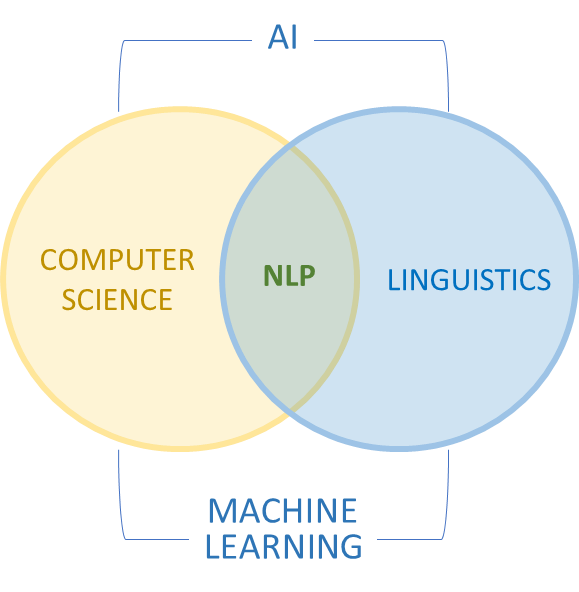

Figure 4. NLP technologies

NLP encompasses a wide spectrum of technologies designed to be integrated into diverse user experiences. It includes deterministic and probabilistic techniques, syntax and semantics methods, named entity recognition (NER), etc.

Nowadays, the use of NLP in virtual assistants is not limited to understand and respond to simple utterances but also to derive meaning and use data behind user queries, allowing them to provide relevant and precise responses resulting in more accurate and natural interactions through different NLP technologies.

Application of NLP as a Service in ATRIA

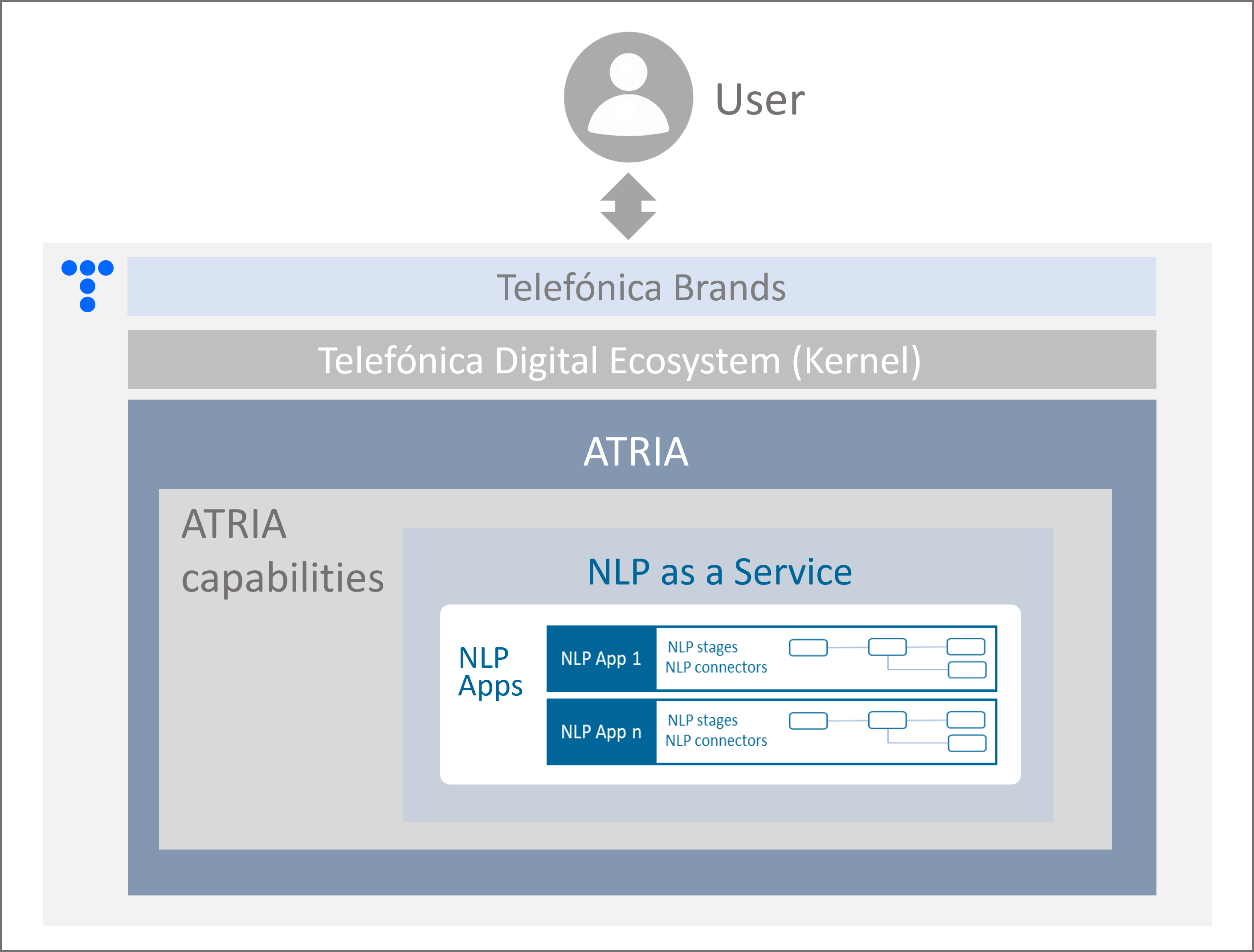
NLP as a Service enables the use of different technologies through NLP Apps (Natural Language Processing recognition stages) for understanding users’ requests and providing back accurate responses.

Currently, these technologies, both proprietary and third-party ones, are included in the Aura NLP component but, in future releases, external NLP methods will be used.

In this framework, constructors have two approaches depending on the utilized stages:

  • Using NLP Apps (NLP recognition stages) different from Semantic Search
    Find here detailed information regarding NLP Apps capability

  • Using Semantic Search technology, a specific NLP App that overcomes traditional keyword-based searches through the use of embeddings.
    Find here detailed information regarding Semantic search functionality
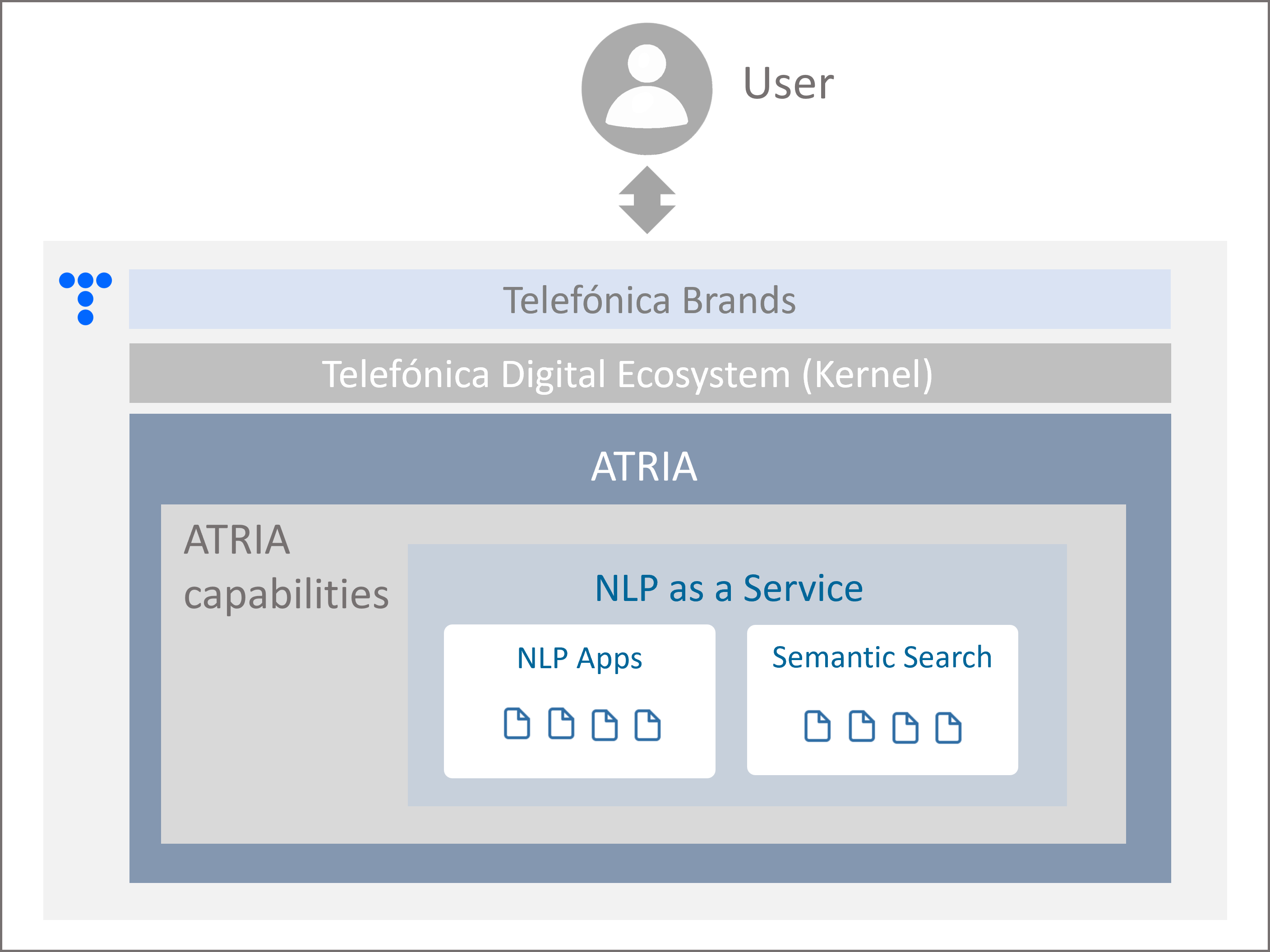

Figure 5. NLP as a Service in ATRIA

Benefits from the use of NLP as a Service

NLP as a Service offers several benefits both for constructors and end-users:

Benefits for use cases constructors

  • Less time and complexity of use cases development
  • It is possible to create and configure tailored NLP pipelines, choosing from a variety of available stages and connectors that cover different aspects of Natural Language Processing.
  • No need for the manual generation of training phrases (aliases) for generic questions knowledge bases.
  • Knowledge bases can be updated continuously in an easy and quick way.
  • Accessibility: any application, both internal and external to Aura Platform, can consume this service.

Benefits for Aura end users

  • End-users can interact with Aura in a natural and conversational way, using their own words and expressions and even informal language, slang, abbreviations, misspellings, etc.
  • Improved Aura’s understanding capabilities, leading to fast and reliable responses and results.
  • Easy update of the knowledge bases, so the users can receive reliable responses based on up-to-date data.
  • The NLP service can be leveraged as capabilities offered to end-users or as internal features used by other Telefonica teams in order to streamline specific internal processes.
1 - NLP Apps

NLP Apps capability

Overview of the NLP Apps capability, encompassing the underlying technology and its application in ATRIA

Introduction to NLP Apps technology

Within Natural language processing (NLP) technologies, NLP Apps refers to NLP pipelines (chains) that combine different technologies for language processing with several tools for combining them.

Currently, these technologies, both proprietary and third-party ones, are included in the Aura NLP component and can be categorized in the following groups:

The technical description of all the available NLP technologies in included in the document Components for NLP pipelines

Application of NLP Apps in ATRIA

ATRIA enables the generation of experiences (use cases) through the use of Aura cognitive capabilities as stand-alone NLP Apps for sending a request expressed in natural language and receiving back an accurate response without the need for a conversational bot.


Figure 6. NLP Apps in ATRIA

Interaction with NLP Apps in ATRIA

This service is accessible via API, enabling its consumption both from Aura Platform or any external application.

Functional overview

A simple overview of the process is provided below:

  • A user sends a request to ATRIA, indicating which specific NLP App she wants to use for the recognition of the request. These Apps are available in Aura NLP, a module of Aura Cognitive Services in charge of processing and understanding human natural language.

  • The NLP technologies in the pre-selected specific App resolves the use case and generates a response.

  • The response is sent back to the user.

2 - Semantic Search

Semantic Search capability

Overview of the Semantic Search capability, encompassing the underlying technology and its application in ATRIA

Introduction to Semantic Search technology

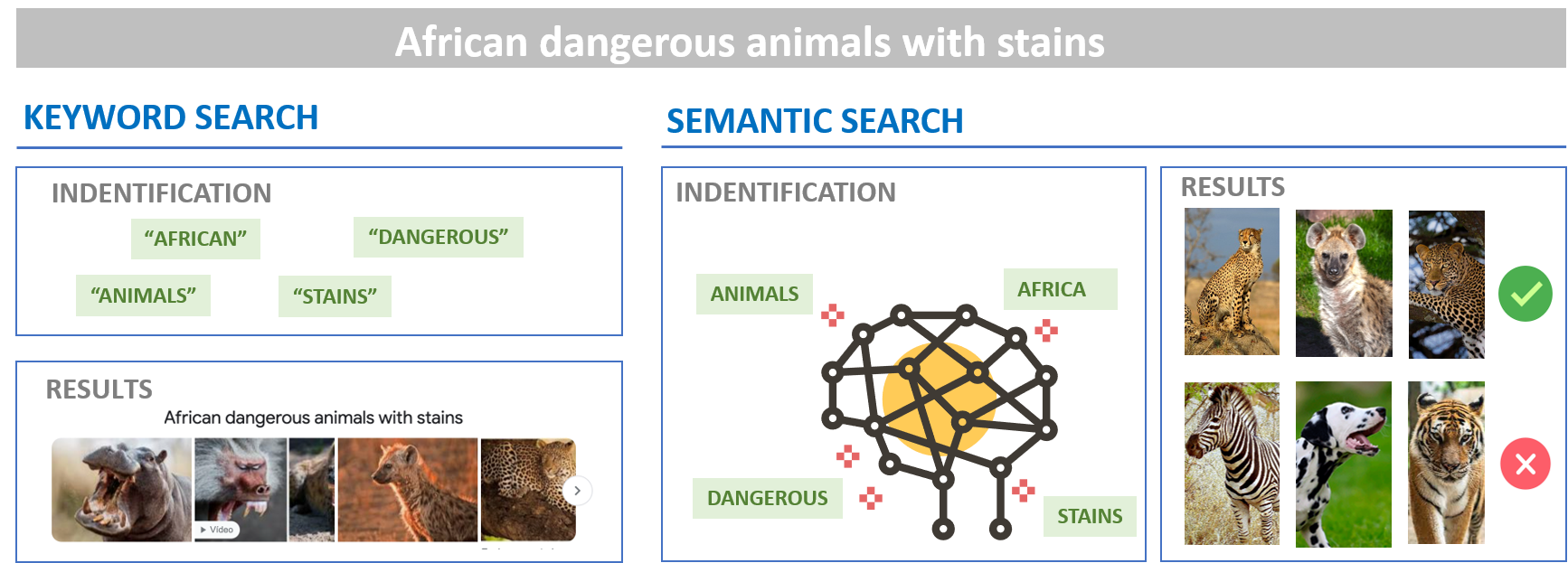
Within Natural Language Processing technologies, Semantic Search goes beyond the traditional keyword-based search methods, as it delves into the intent and the meaning behind a query, interpreting the meaning of words and phrases.

This leads to the generation of more accurate and relevant search results that align closely with the user’s intent.

For this purpose, semantic search uses neural network embeddings: a representation of words or phrases in a continuous vector space that captures the semantic relationships between them. This information is crucial for semantic search to interpret the user’s intent accurately.


Figure 7. Semantic Search technology

Application of Semantic Search in ATRIA

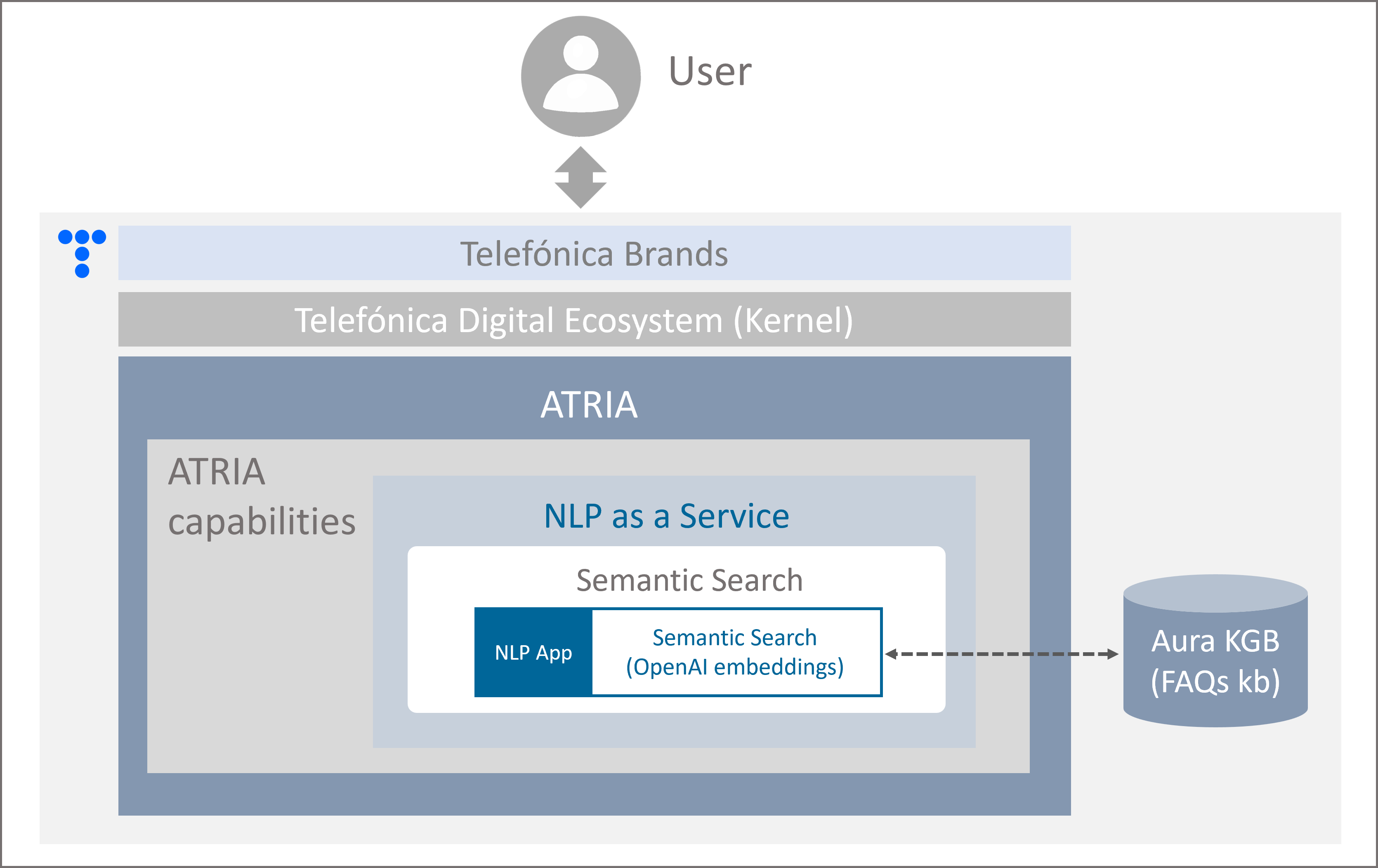
Semantic Search is a specific NLP App, included in the NLP as a Service capability.

ATRIA benefits from the Semantic Search capability based on embeddings for the development of generic questions experiences (grounded in FAQs).
It allows achieving an accurate understanding of requests and the generation of highly reliable answers, fully aligned with the user's expectations.


Figure 8. Semantic Search in ATRIA

Interaction with Semantic Search in ATRIA

This service is accessible via API, enabling its consumption both from Aura Platform and any external application.

Semantic search technology is available in Aura through a specific Aura NLP stage: OpenAI embeddings.

Current available models

Semantic Search currently uses Azure OpenAI embeddings technology.

Check the version of the model here.

Functional overview

The use of this capability encompasses three different stages:

  • Preparation, for the creation of the use case knowledge bases with the required FAQs and associated answers, and the subsequent generation of embeddings with this information.

  • Identification, in which a user sends a request to ATRIA, selecting as the specific NLP App the one that includes the semantic search technology (OpenAI embeddings). This app recognizes the user’s request.

  • Answer generation: the best response to the user request is identified and sent back to the user.